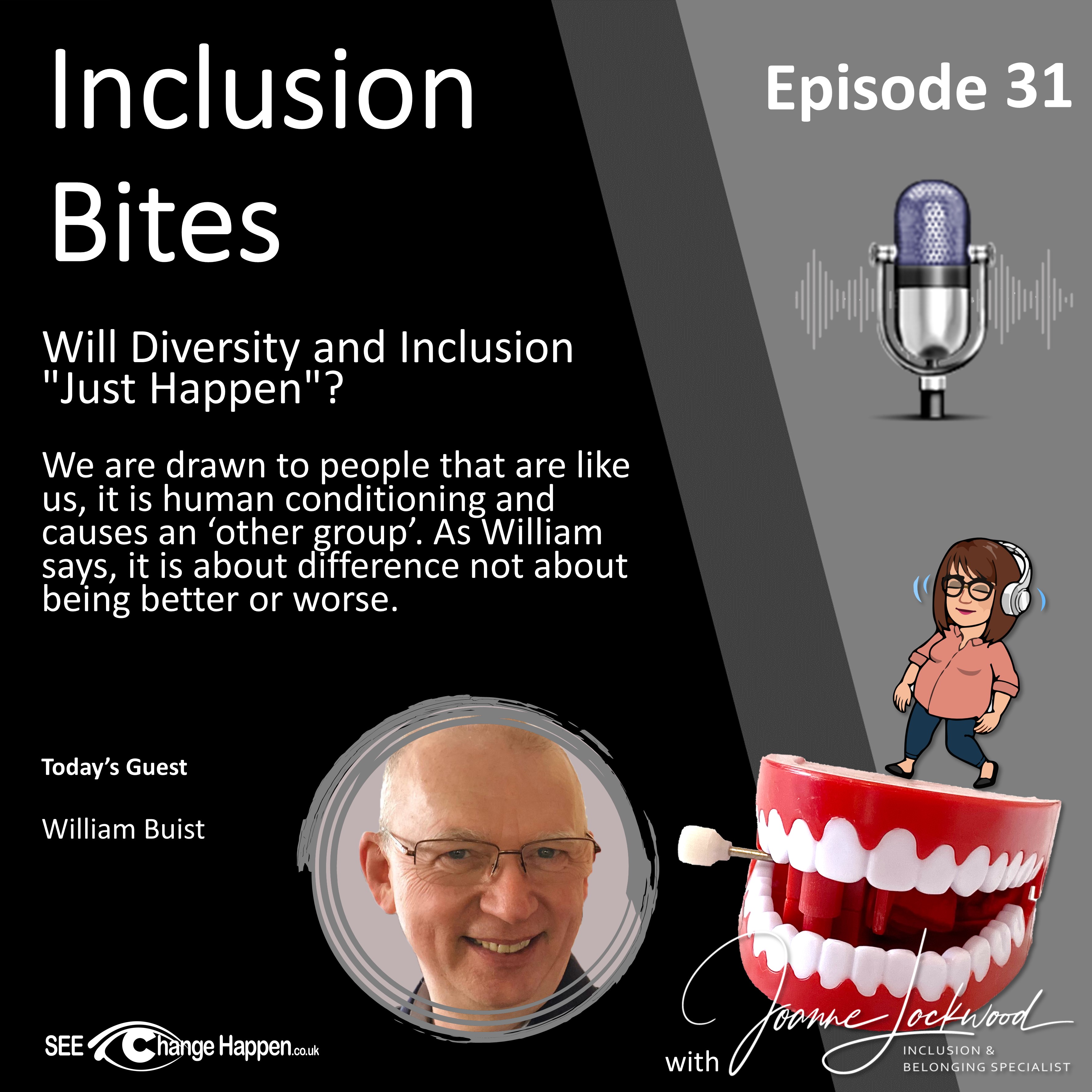
Will Diversity And Inclusion "Just Happen"?
with William Buist · 11 March 2021
Workplace Culture Systems
Joanne Lockwood is joined by business strategist William Buist to explore whether diversity and inclusion will naturally improve over time, or whether it requires deliberate action. They discuss how legislation can create the illusion that equality has been achieved, while everyday systems and norms still produce unequal outcomes.
William reflects on the invisibility of privilege for those who have it, and why allyship often looks like many small, intentional “nudges” rather than grand gestures. The conversation moves into how networking and referral habits can unintentionally reinforce sameness, and how widening personal and professional circles can create opportunity and learning for everyone.
They examine inclusion and accessibility in both physical and online settings, noting that remote working can reduce some barriers while introducing others. The episode also explores how recruitment and “merit” measures (like years of experience) can embed bias, and why organisations need to redesign processes and culture to make change stick. Throughout, the focus is on practical culture change, dialogue, and building a workplace and society where people are valued for what they bring rather than excluded by outdated assumptions.
About William Buist
One-sentence summary
William Buist’s quiet conviction is that fairness will not emerge by accident — it grows when those with comfort and access choose to notice, include, and reshape the systems that once benefited them.
---
Synopsis
William Buist speaks as a man who has slowly come to see the water he has always swum in. A self-described “white bloke” who recognises he has moved easily through doors others struggle to open, he does not wear guilt as a badge — he wears responsibility. His curiosity is not just professional; it is personal. Over years of working with businesses, building networks, and observing who gets referred, hired and heard, he began noticing absence. His address book was full of people who looked like him. His industry history echoed the same pattern. What changed him wasn’t theory — it was exposure, proximity, friendship. It was sitting in the audience to listen to someone different from him and discovering not only talent but mutual growth.
He is trying to change something deeper than policy — he is challenging the quiet autopilot of familiarity. He believes exclusion most often happens without malice, through habit and inherited systems. But “too slowly” is not good enough. For William, inclusion is not revolution but evolution — deliberate, consistent nudges that accumulate. It is about lifting “the parts of the playing field that are struggling” rather than pushing others down. At its heart, his work is about dignity: seeing people for who they are, not for the boxes systems place them in. He wants a world where diversity is no longer an initiative but simply how humanity operates.
---
10 Small, digestible concepts for easy learning
1. Privilege is often invisible to the person who has it.
If doors open every time, you may never notice they were heavy for others.
2. Inclusion doesn’t just happen — it is chosen.
Left alone, systems tend to repeat themselves.
3. Familiarity shapes opportunity.
We refer and recruit from who we already know — and that quietly narrows possibility.
4. Merit can hide bias.
When “experience” is measured by history shaped by exclusion, it perpetuates inequity.
5. Difference is not hierarchy.
“People like me” is a natural instinct — but different does not mean better or worse.
6. Small nudges create real change.
Inclusion grows from consistent, everyday acts of widening the circle.
7. Exposure reduces fear.
Fear of the “other” weakens when we share space and stories.
8. Culture is simply ‘the way we do things around here’.
If that way excludes people, the culture must change — not the people.
9. Being right matters less than understanding.
Growth begins when we try to prove ourselves wrong.
10. The goal is maturity, not compliance.
True inclusion shows up in who we are, not just in what policies say.
---
The “why” in the story
What they believe is true about people
People are just people — thinking, feeling, capable of value regardless of background or circumstance.
What they cannot unsee
The quiet, systemic advantage that flows towards certain groups — including himself — without effort or awareness.
What they are no longer willing to tolerate
The excuse that “it will just happen” or that hiring “on merit” alone solves inequity when the system defining merit is skewed.
What they are trying to build instead
A culture where opportunity is broadened intentionally, where talent is sought beyond familiarity, and where inclusion becomes habitual rather than performative.
---
Narrative structure
1. The trigger
Realising his own professional network mirrored historical patterns — overwhelmingly white and male — and understanding that absence wasn’t accidental.
2. The tension
The internal conflict of benefiting from privilege while wanting fairness. The external resistance from organisations overwhelmed by the perceived scale of change.
3. The insight
Bias often hides in process, not intention. Requirements like “20 years’ experience” quietly recreate yesterday’s inequalities.
4. The pivot
Choosing to act deliberately — expanding his network, examining recruitment criteria, encouraging organisations to question what they are truly measuring.
5. The destination
A world mature enough not to need the language of diversity and inclusion, because fairness has become instinctive.
---
Five key takeaways and learning points
1. If you are comfortable, you likely hold unseen advantage.
And recognising that is the beginning of responsibility, not condemnation.
2. Systems outlive good intentions.
Unless we examine process, bias reproduces itself quietly.
3. Exposure changes perspective faster than argument.
Shared experiences reduce fear more effectively than debates.
4. Hiring for potential is as powerful as hiring for history.
Talent grows when given access, not only when credentials align perfectly.
5. Inclusion must stick.
Real change is cultural — it survives beyond being watched.
---
Ten distinct ideas explained
1. Unintentional bias is still impactful.
You can exclude people without ever intending harm; the emotional impact on them is the same.
2. Meritocracy needs interrogation.
When the pathway to “merit” has only been open to some, the measure is flawed.
3. Othering stems from fear.
Fear diminishes when we replace imagination with real encounters.
4. Representation shapes belonging.
When we see ourselves reflected, we feel permitted to participate.
5. Isolation within inclusion is damaging.
Hiring someone different without shifting culture leaves them visibly alone.
6. Accessibility is evolving, not solved.
Moving online removed barriers for some but created new ones for others.
7. Language shapes limits.
“Hit the ground running” can conceal a desire for sameness.
8. Culture change is relational.
Policies matter less than daily interactions that either welcome or exclude.
9. Curiosity is a superpower.
Asking “What am I missing?” interrupts automatic thinking.
10. Mastery is about being, not proving.
True growth shows in how we elevate others, not how we defend ourselves.
---
How people should change as a result
1. Think
- Move from “I treat everyone the same” to “Do my systems advantage some more than others?”
- Question whether experience requirements reflect skill or historic access.
- See inclusion as growth, not loss.
- Replace “Who fits?” with “Who is missing?”
2. Feel
- Shift from defensiveness to reflection.
- From guilt to responsibility.
- From fear of getting it wrong to willingness to learn.
- From comfort in sameness to curiosity about difference.
3. Act
- Review one recruitment or selection criterion and ask what it truly measures.
- Intentionally expand your professional circle beyond familiarity.
- Amplify one voice in a meeting that might otherwise be overlooked.
- Ask someone about their lived experience — and listen without debating.
- Ensure events or content are accessible beyond the obvious defaults.
- Refer someone different from you for an opportunity.
- Reflect monthly on where your own “address book” lacks diversity.
---
One thing to remember
Fairness does not emerge from comfort — it grows when those with open doors choose to widen them.